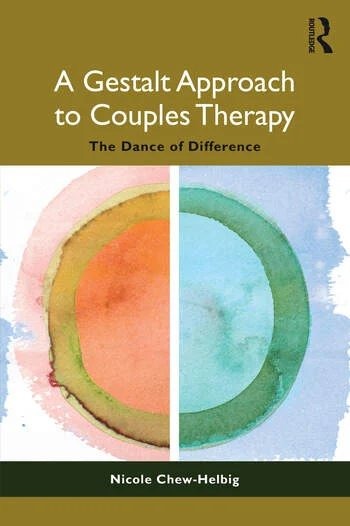
A Gestalt Approach to Couples Therapy: The Dance of Difference — Nicole Chew-Helbig
← All books Routledge

A Gestalt Approach to Couples Therapy

The Dance of Difference

What if the tension between two people — the very thing that makes intimacy difficult — is also what makes it real? This book examines the paradox of connection: how genuine meeting emerges when we stop trying to eliminate difference and start learning to dance with it.

ISBN: 978-1041051466
Routledge, March 2026
Paperback & Hardcover

“Contact happens at the boundary where two people experience their otherness.”

— from The Dance of Difference

About the Book

Couples arrive in therapy because something hurts. Usually they believe the problem is the other person — the silence, the criticism, the withdrawal, the pursuit. What they discover, if the therapy is honest enough, is that the pain lives in the space between them: at the contact boundary where difference meets desire.

This book offers a framework grounded in Gestalt therapy for working with that space. It draws on Kurt Lewin's field theory, Martin Buber's philosophy of meeting, and Salomo Friedlaender's creative indifference to propose that genuine connection does not require the elimination of difference. It requires the opposite: the courage to stay present to another person's irreducible otherness — and to let yourself be seen in yours.

Through detailed clinical narratives, cross-cultural perspectives shaped by practice across Vienna and Singapore, and a deep engagement with relational theory, the book demonstrates how therapists can cultivate the conditions for authentic contact — where conflict becomes the material of intimacy rather than its enemy.

For therapists, the book provides innovative strategies for fostering presence, differentiation, and creative transformation. For couples, it opens the possibility that the very differences tearing them apart contain the seeds of deeper connection.
Companion Essay

How does a Gestalt approach to couples therapy compare with EFT, the Gottman Method, IFS, and the work of Esther Perel? This essay examines the philosophical foundations, theories of change, and clinical positions that distinguish — and connect — these modalities.

Read on Academia.edu →

Inside the Book

Introduction: The Dance of Difference
"When two become one", says Bob and Rita Resnick, "there's none." Why the fusion model of relationships leaves couples unable to feel each other — and how the connection model offers a radical reframe.
  1. Part I — Foundations of Presence
  2. First Contact: The Phenomenological Encounter
    What happens when the therapist sets aside diagnosis and simply attends to what is present — the first act of meeting a couple where they are.
  3. Trauma in the Relational Field
    How survival strategies forged in earlier life become the creative adjustments that shape — and sometimes trap — the couple's present.
  4. Part II — The Paradox of Change
  5. The Paradoxical Theory of Change in Couples Work
    Transformation happens by fully accepting what is, rather than coercing partners to be different — the complete paradoxical journey.
  6. The Transformative Role of Experiments in Gestalt Couples Therapy
    From talk to action: how experiments — role reversal, object exchange, the empty chair — move couples beyond intellectualising and into embodied contact.
  7. Part III — The Field and Connection
  8. Field Theory in Couples Therapy
    Relationships exist within webs of influence — cultural expectations, family histories, present circumstances — and the therapist participates in, rather than observes, the field.
  9. Shame, the Pathos of the Field
    Shame resides at the contact boundary — the vulnerable moment of being truly seen — and is often the primary force that freezes the cycle and drives partners into isolation.
  10. The Cycle of Connection: Movement Between Contact and Withdrawal
    The five phases of the connection wave — withdrawal, contact, intimacy, confluence, and isolation — and what happens when couples get stuck between them.
  11. Part IV — Integration and Practice
  12. Creative Indifference: Conflict and the Therapist's Centred Presence
    Friedlaender's concept applied to couples work — the therapist's capacity to hold both sides without taking either, creating space for something new to emerge.
  13. Integration with Other Modalities
    How a Gestalt approach sits alongside EFT, the Gottman Method, IFS, and the work of Esther Perel — what it shares, where it diverges, and why it matters.
Conclusion: Beyond the Therapy Room
What happens when the principles of contact, difference, and presence extend beyond the clinical setting — into the way we live together.

Listen & Watch

Excerpts from the book, explored as conversations — generated from NotebookLM and brought to life as short podcast episodes and video summaries.

Podcast Episode
Why "Two Becoming One" Destroys Intimacy
The romantic ideal of merging with another person may be the very thing that kills real connection — and what Gestalt therapy offers instead.
Podcast Episode
The Metaphor That Changes How We View Connection
A single image from the book that reframes what it means to be in relationship — and why the space between two people is where love actually lives.
Podcast Episode
Why Trying to Change Your Partner Always Backfires
The paradox of change in couples therapy: transformation only happens when we stop demanding it — and start meeting the other person where they are.
Podcast Episode
Stop Talking. Start Rolling the Ball.
When words become weapons or walls, sometimes the most powerful intervention is the simplest one — moving out of language and into embodied contact.

Key Ideas at a Glance

Visual summaries of core concepts from the book — designed for therapists, students, and anyone navigating the complexities of relationship.

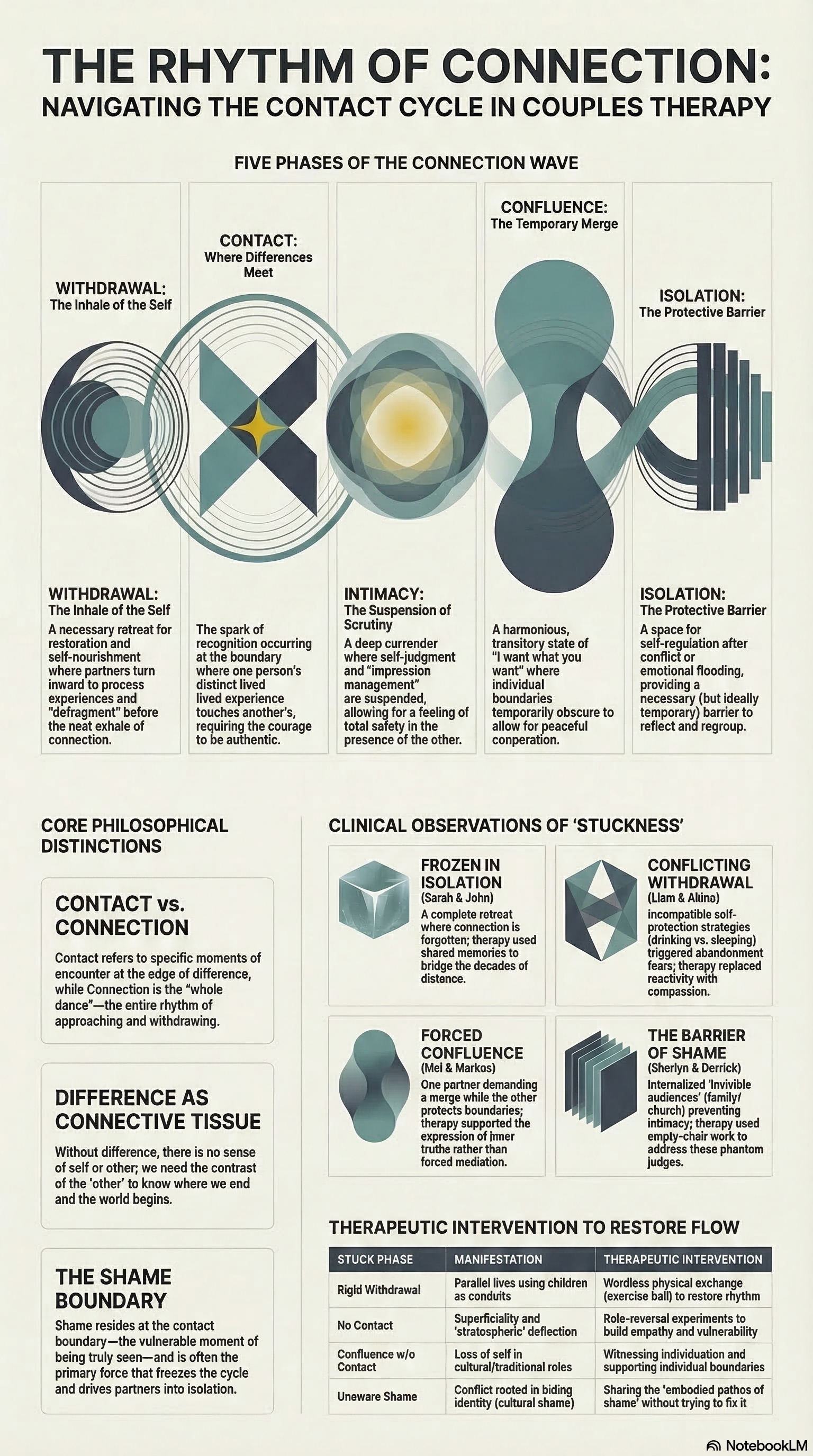
The Rhythm of Connection: Navigating the Contact Cycle in Couples Therapy — five phases of the connection wave, clinical observations of stuckness, and therapeutic interventions to restore flow
Infographic
The Rhythm of Connection
The five phases of the contact cycle — withdrawal, contact, intimacy, confluence, and isolation — and how couples get stuck between them. Includes clinical case examples and therapeutic interventions to restore flow.
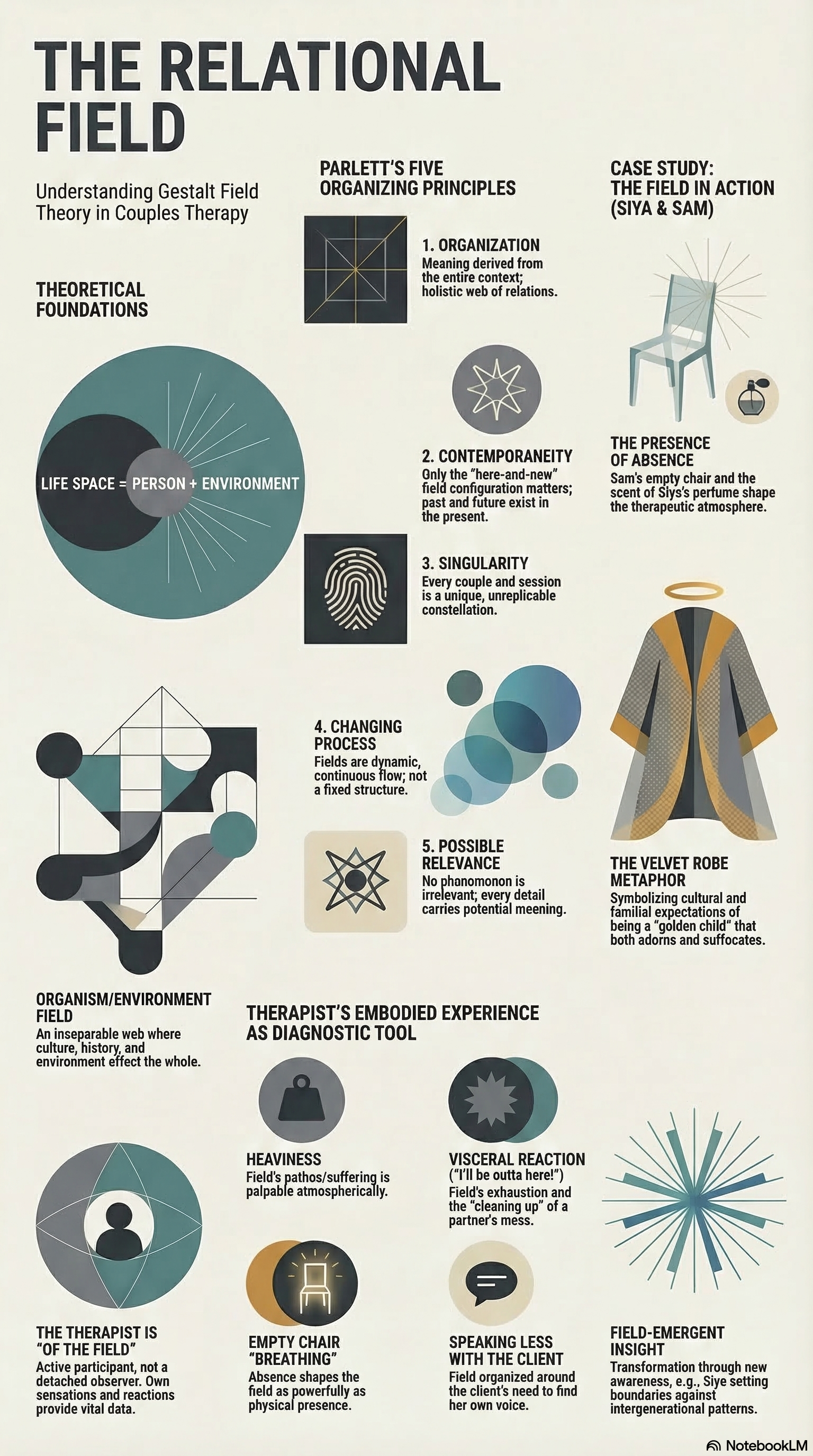
The Relational Field: Understanding Gestalt Field Theory in Couples Therapy — Parlett's five organising principles, the therapist's embodied experience as diagnostic tool, and clinical case study
Infographic
The Relational Field
Parlett's five organising principles applied to couples work — organisation, contemporaneity, singularity, changing process, and possible relevance — alongside the therapist's embodied experience as a diagnostic tool.
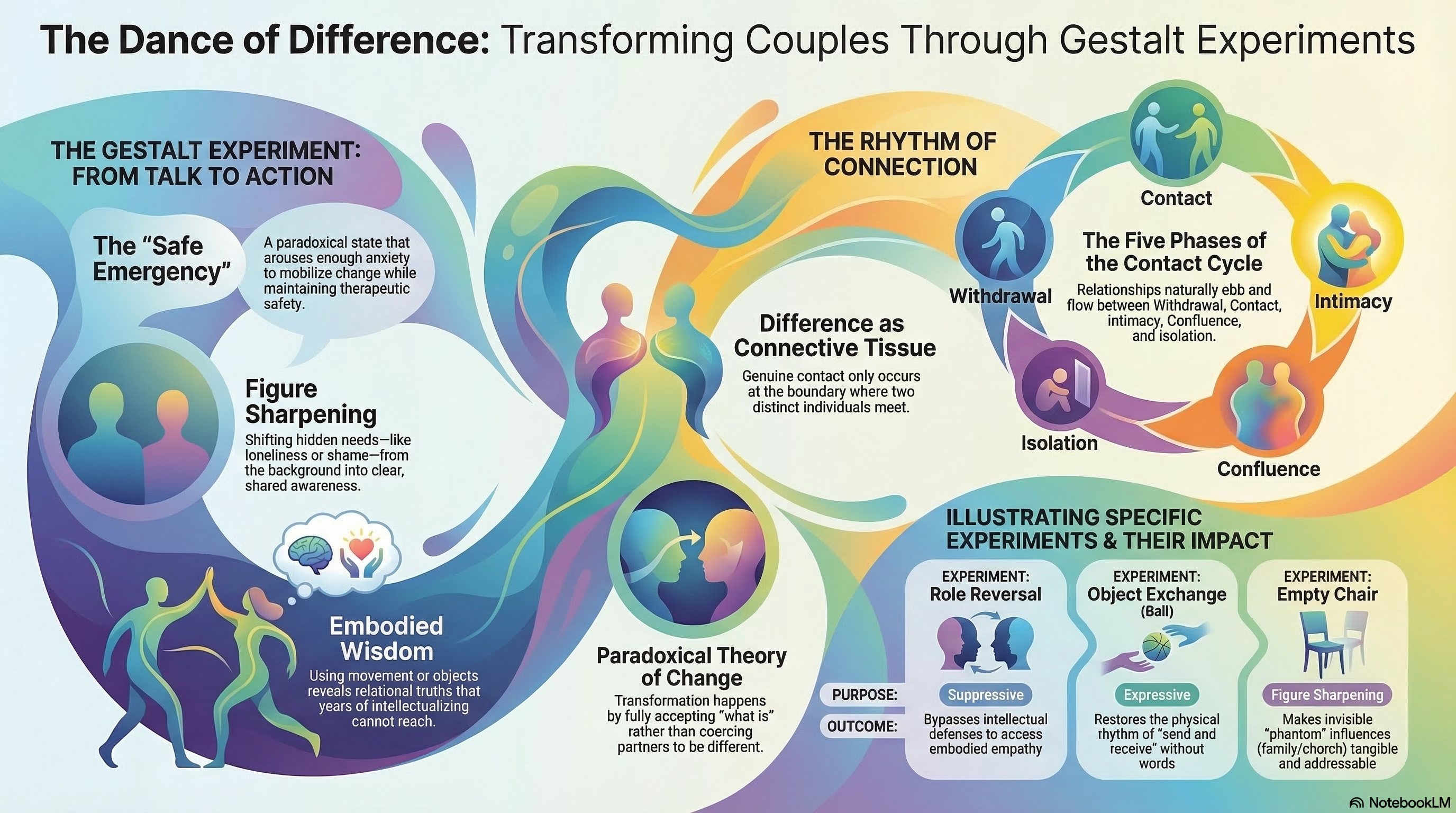
The Dance of Difference: Transforming Couples Through Gestalt Experiments — the safe emergency, figure sharpening, embodied wisdom, the paradoxical theory of change, and specific experiments including role reversal, object exchange, and empty chair
Infographic
Transforming Couples Through Gestalt Experiments
From talk to action: how Gestalt experiments — role reversal, object exchange, and the empty chair — move couples beyond intellectualisation and into embodied contact, where genuine transformation becomes possible.

Where This Work Leads

The couples therapy described in this book led directly to a larger question: if the courage to be seen is what heals relationships, what is the emotion that makes that courage so terrifying? The answer became The Shame Paradox — a book that traces shame from its origins in infant neurobiology to its place in consciousness itself.

Explore The Shame Paradox

Stay Connected

Occasional writing on consciousness, relationship, and what it means to be human.

Connect to your email service